
Concrete Permits in Broward County: What Homeowners Need to Know
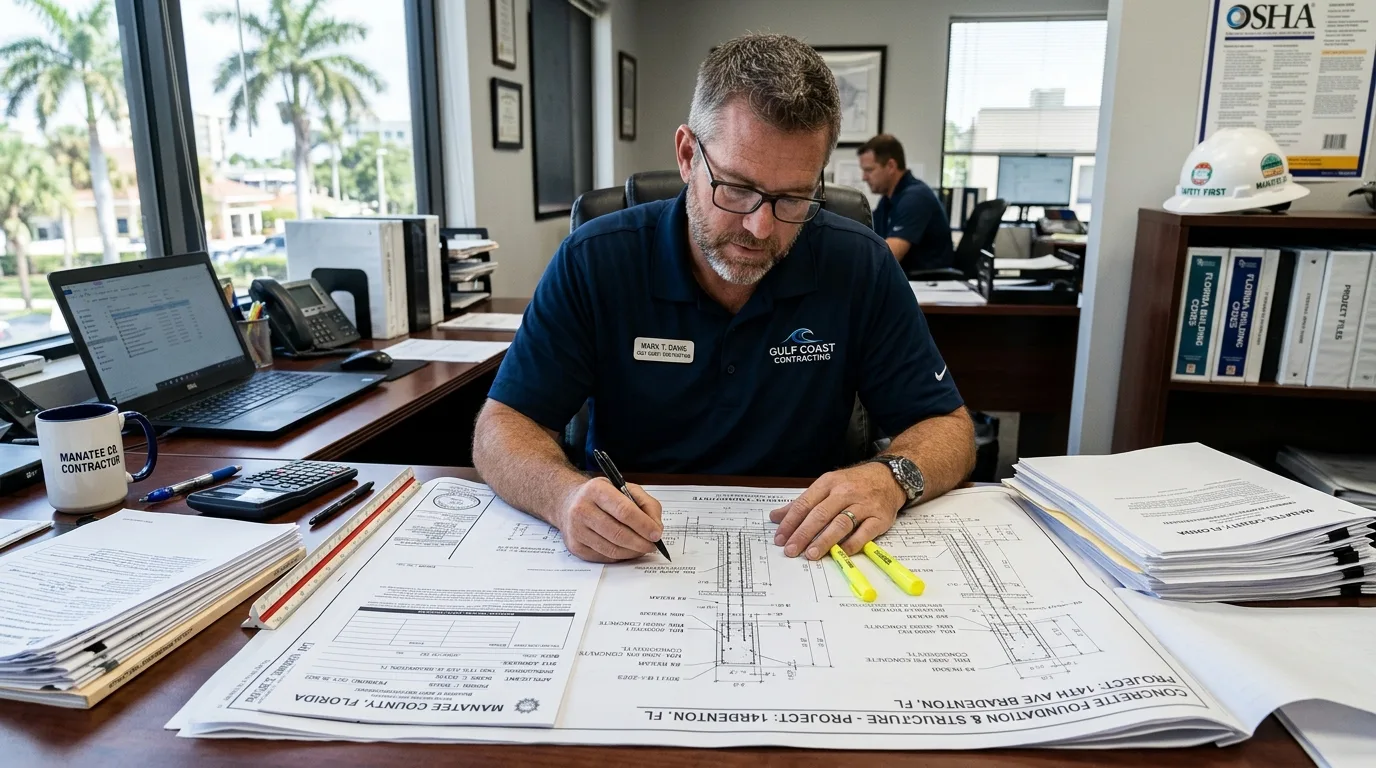
Skipping the permit process on a concrete project in Broward County is a risk that can result in stop-work orders, fines, forced removal of completed work, and complications when you sell your home. The good news is that the permitting process, while detailed, is well-defined — and a qualified contractor handles most of it on your behalf. In this post, we’ll cover exactly what Broward County requires for concrete permits, how long the process takes, and what the rules mean for your specific project.
Call +1(888)376-0955 to speak with our team about permitted concrete work in Broward County. We handle the paperwork.
Why Permits Matter for Wilton Manors Homeowners
Broward County sits on the Atlantic Coastal Ridge with oolitic limestone bedrock overlaid by sandy fill. Sandy soils drain rapidly but have poor load-bearing without proper compaction; oolitic limestone near the surface can create uneven settlement. South Florida’s hot-humid climate — wet season (June–September) with daily thunderstorms and hurricane risk, dry season (November–April) with temperatures 50–85°F — means that concrete installations here face unique structural demands.
The permitting process exists precisely because of these conditions. Inspections verify that subbase compaction meets the minimum bearing requirements, that slab thickness complies with code minimums, and that reinforcement is correctly placed. This protects not just your property but the entire neighborhood’s drainage patterns and infrastructure. A driveway installed without proper grade can redirect stormwater onto neighboring lots — an especially acute concern in South Florida’s intense wet season. Beyond safety, an unpermitted concrete structure discovered during a home sale can derail the transaction or require expensive removal and reinstallation.
What Broward County Requires for Concrete Permits
Broward County’s building code has specific, non-negotiable requirements for concrete driveway and slab permits. Here is what the code mandates, verbatim from the county’s building requirements:
Permit required for driveways and concrete slabs. Broward County requires a permit for driveways and concrete slabs. Two complete plan sets with a Registered Land Surveyor’s Certificate are required for the application. Plan review takes up to 15 business days. For projects valued at $5,000 or more, a Notice of Commencement must be filed with Broward County Records prior to the first inspection. Minimum concrete thickness is 4 inches on compacted sand or crushed rock; pool deck and screen patio edges require 8×8 inch footings with continuous #5 bar. ePermits are available online via broward.org/building.
Breaking this down for a typical homeowner project:
Two complete plan sets — You’ll need two copies of a site plan showing property lines, existing structures, the proposed concrete area dimensions, and drainage direction. Your contractor typically prepares these drawings.
Registered Land Surveyor’s Certificate — This requires a licensed surveyor to certify the accuracy of the site plan. Surveyor fees in Broward County typically run $300–$600 for a residential survey, depending on lot size and complexity.
15 business days for plan review — Three calendar weeks is the standard expectation, though review times can vary based on permit office volume. This review period should be factored into your project timeline from the start. Don’t schedule a pour before you have your permit in hand.
Notice of Commencement for projects $5,000+ — If your concrete project is valued at $5,000 or more (which includes most full driveway installations), a Notice of Commencement must be filed with Broward County Records, Division of Records, Taxes & Treasury before the first inspection can occur. This document protects both the property owner and contractors by establishing the start of the improvement lien period under Florida’s Construction Lien Law.
Minimum 4-inch slab thickness — This is the code minimum on a properly compacted subbase of sand or crushed rock. For heavier loads — RVs, boats, heavy trucks — a 5- or 6-inch slab is advisable even if not strictly required.
Pool deck and screen enclosure edges — These require 8×8 inch footings with a continuous #5 rebar bar. This is a meaningful structural requirement that differentiates pool deck installations from a basic flatwork pour. Contractors who attempt to pour pool deck edges without proper footings are creating a code violation and a structural liability.
Types of Concrete Projects Requiring Permits
- New driveways: Always require a permit in Broward County, including complete replacement of an existing driveway.
- Concrete patios and slabs: Any slab attached to or within a certain setback of the home requires a permit. Freestanding patio slabs may still require one depending on size.
- Pool decks: Always permitted; the 8×8 footing requirement with #5 bar applies at all coping edges.
- Screen enclosure slabs: Permitted, with the same footing requirements as pool decks at perimeter edges.
- Concrete additions: Adding to an existing slab requires a permit even if the original was permitted.
For pricing context on driveway and slab projects, see our guide on concrete driveway costs in Fort Lauderdale and Broward County.
How the Permit Process Works Step by Step
The permit process, while it requires some coordination, follows a predictable sequence when managed by an experienced contractor.
Step 1 — Site assessment and drawings: Your contractor visits the site, takes measurements, and prepares or coordinates the preparation of two sets of site plans. If a survey is needed, a Registered Land Surveyor is engaged at this stage.
Step 2 — Application submission: The application, plan sets, and surveyor’s certificate are submitted to the Broward County Building Division, either in person or through the online ePermits portal at broward.org/building.
Step 3 — Plan review (up to 15 business days): The county reviews the plans for code compliance. If there are comments or corrections required, the contractor addresses them and resubmits.
Step 4 — Permit issuance: Once approved, the permit is issued. For projects $5,000+, the Notice of Commencement must be filed before any inspections can be scheduled.
Step 5 — Construction and inspections: Work proceeds according to the approved plans. Inspections are scheduled at required milestones — typically a subbase/forms inspection before the pour and a final inspection after the slab has cured.
Step 6 — Certificate of completion: Once all inspections pass, the permit is closed and a certificate of completion is issued.
Ready to get your project permitted and underway? Call +1(888)376-0955 — we manage the permit process from start to finish.
Cost Factors Related to Permitting
Permit fees in Broward County are based on project value and are set by the county’s fee schedule. For a typical residential concrete project, expect:
Permit fee: $150–$500 depending on project scope and valuation. The county calculates fees as a percentage of the declared project value.
Surveyor fee: $300–$600 for a standard residential survey if one is not already on file. If your property was recently surveyed for another project, your contractor may be able to use the existing survey with updated documentation.
Notice of Commencement filing: A nominal recording fee applies when filing with Broward County Records.
These costs should be included in your contractor’s bid as line items. A contractor who quotes you a price and doesn’t mention permits or surveying costs is either planning to do the work unpermitted (a serious red flag) or will present these as surprise costs later. Always verify that your quote explicitly includes permit management.
For information on the concrete work itself — the driveway installation services we provide — visit our services page.
Frequently Asked Questions
What happens if I pour concrete without a permit in Broward County?
The county can issue a stop-work order and require that the unpermitted structure be removed at your expense. When you sell your home, unpermitted work disclosed on a property disclosure or discovered by an inspector can derail the sale or require costly remediation. There is no scenario where skipping the permit saves money in the long run.
Can my contractor pull the permit for me?
Yes — and in most cases, they should. Licensed contractors in Broward County are authorized to pull permits on behalf of property owners. This is the standard practice and is part of what you’re paying for when you hire a licensed, insured contractor. Verify that your contractor holds a current Broward County contractor’s license before signing any contract.
How do I check the status of a permit application?
Permit application status can be checked through the online ePermits portal at broward.org/building. You’ll need the permit application number, which your contractor should provide. You can view the application status, plan review comments, and inspection results through the portal.
Navigating Broward County’s permitting requirements is a manageable process when you work with a contractor who understands the system. Our team has pulled hundreds of residential concrete permits across Wilton Manors, Fort Lauderdale, Oakland Park, and the surrounding area.
Call +1(888)376-0955 to discuss your project. We handle permits, scheduling, and inspections so you don’t have to.
Related Posts: