
Concrete vs. Pavers in Fort Lauderdale: Which Is Right for Your Project?
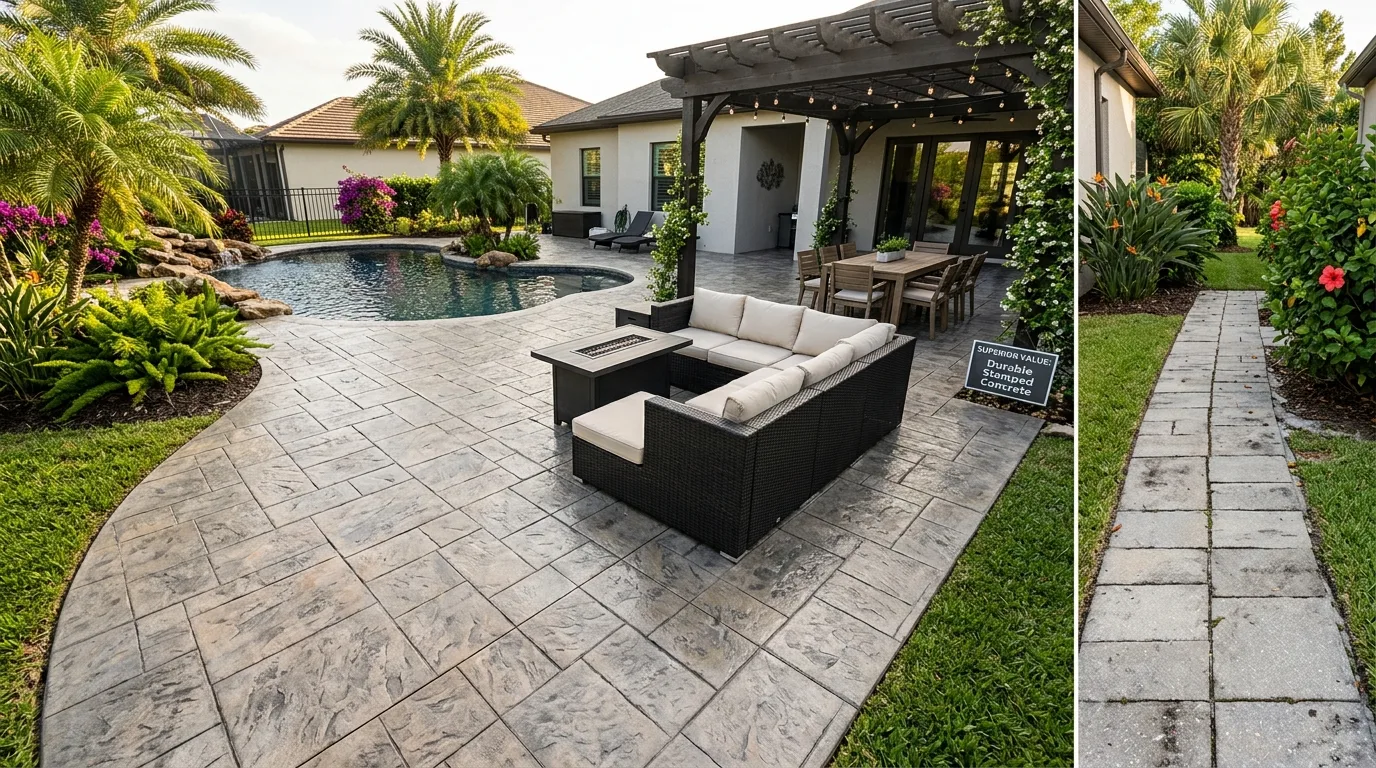
When Fort Lauderdale and Wilton Manors homeowners are planning a driveway, patio, or pool deck, the concrete vs. pavers question comes up in nearly every conversation. Both materials work well in South Florida — but they perform differently in our specific climate, carry different long-term cost profiles, and suit different aesthetic goals. In this post, we’ll cover durability in South Florida conditions, upfront and long-term costs, maintenance requirements, and which applications each material handles best, so you can make a confident decision before calling for bids.
Call +1(888)376-0955 for a free estimate on your driveway, patio, or pool deck project in Fort Lauderdale and Broward County.
Why Material Choice Matters for Wilton Manors Homeowners
Broward County’s climate creates conditions that expose every weakness in an outdoor surface material. The wet season runs June through September with daily afternoon thunderstorms and high humidity. During this period, surfaces are repeatedly saturated and then subjected to intense sun. The dry season from November through April offers more moderate temperatures of 50–85°F, which is actually the ideal window for installing both concrete and pavers. Salt air from the Atlantic accelerates corrosion of uncoated metal reinforcement in concrete and can stain and degrade the sealer on pavers. UV radiation is intense year-round.
Sandy soils with variable load-bearing capacity mean that subbase preparation is critical for both materials. Pavers installed on a poorly prepared base will settle and shift rapidly in South Florida’s wet-dry cycle. Concrete poured over an uncompacted base cracks. Neither material is forgiving of shortcuts in the base preparation phase — which is why contractor quality matters as much as material choice in Broward County.
Types and Options: Concrete Finishes vs. Paver Styles
Standard broom-finish concrete is the baseline for comparison. It’s a single continuous slab with a slightly textured surface for traction. Installation costs $3.94–$7.87 per square foot in Broward County. It requires no joint maintenance, handles heavy loads consistently, and when sealed, resists staining and UV degradation well.
Stamped and decorative concrete bridges the gap between plain concrete and the aesthetic variety of pavers. Stamped concrete at $14–$28 per square foot can realistically replicate brick, cobblestone, slate, or tile patterns — often at a lower total cost than actual pavers of similar visual quality. For patios and pool decks, stamped concrete is a direct competitor to pavers in both appearance and price. See our dedicated post on stamped concrete patios in Wilton Manors for design options.
Interlocking concrete pavers are individual units — typically 2.375 inches thick for driveways — set in a sand bed over a compacted aggregate base. The individual units allow for some flexibility, which can be advantageous in areas prone to minor ground movement. Paver installation typically runs $15–$25 per square foot installed in Broward County, depending on pattern complexity and paver type.
Natural stone pavers — travertine, marble, limestone — command a premium of $20–$40+ per square foot installed. Travertine is particularly popular in South Florida for pool decks because its naturally porous surface stays cooler underfoot than concrete or solid pavers. However, natural stone requires more maintenance to prevent staining and algae growth in humid climates.
Permeable pavers are a specialized option designed to allow rainwater to pass through the joint material and into the subbase. In South Florida’s high-rainfall environment and increasingly stringent stormwater management regulations, permeable pavers can be an advantage in certain applications, though they require regular maintenance to keep joints free of debris.
Practical Uses: When to Choose Each Material
- Driveways (concrete): For straightforward driveways where load capacity, longevity, and minimal maintenance are the priority, concrete is typically the better choice. A concrete driveway with a quality sealer will outlast a paver driveway installed on a comparable budget, primarily because there are no joints to settle or weeds to penetrate.
- Driveways (pavers): When curb appeal and design variety are the priority, pavers offer more pattern and color options than plain concrete. Individual paver replacement is easier than concrete patching when damage occurs.
- Patios (concrete): Stamped concrete patios compete directly with pavers on aesthetics at a similar price point.
- Patios (pavers): Pavers allow for complex patterns, mixed materials, and the ability to lift and relay sections if utility access is needed beneath.
- Pool decks: Both materials work, but the specific requirements differ. See our pool deck concrete guide for detailed pool deck options.
- Walkways and paths: Both work well. Pavers are easier to install in irregular shapes without cutting; concrete requires forms and more setup for complex curves.
How the Installation Process Compares
Both concrete and pavers demand proper subbase preparation — this is the single most important factor for longevity in South Florida’s soil conditions. The processes diverge after subbase prep.
Concrete installation involves forming, rebar placement, pouring, finishing, and sealing. The pour is a single event; once the concrete is placed and cured, the slab is essentially monolithic. This is both a strength (no joints) and a limitation (repairs require cutting and patching). Broward County requires a permit for concrete driveways and slabs; review our full guide on concrete permits in Broward County.
Paver installation involves base compaction, bedding sand layer, individual unit placement, edge restraint installation, joint sand compaction, and sealing. The labor is more distributed — no single time-sensitive pour — but the process requires careful attention to slope and alignment throughout. Permits are also required for paver driveways in Broward County; check local requirements.
Mid-project decision point: If you’re on the fence at bid time, ask contractors to price both options for your project. In many cases, the final numbers are closer than expected, and the decision comes down to aesthetics and maintenance preference.
Call +1(888)376-0955 — we can price both concrete and paver options and give you an honest comparison for your specific project.
Cost Factors in Broward County
Concrete advantages on cost:
- Lower material cost for standard finishes ($3.94–$7.87/sqft vs. $15–$25/sqft for pavers)
- No ongoing joint sand replenishment costs
- Longer lifespan typically translates to lower cost per year of use
- Sealing every 2–3 years is the primary ongoing maintenance expense
Paver advantages on cost:
- Individual unit replacement is less expensive than concrete patching for isolated damage
- If utilities run beneath the surface, paver removal and replacement is far cheaper than concrete cutting
- Some paver patterns require no cutting for standard-dimension spaces, reducing labor cost
Where costs converge:
- Decorative concrete ($14–$28/sqft) and pavers ($15–$25/sqft) overlap significantly in price, making aesthetics the deciding factor at this tier
- Subbase preparation costs are comparable for both materials
- Permit costs are similar regardless of surface material
For the full pricing breakdown on concrete specifically, see our post on concrete driveway costs in Wilton Manors.
Maintenance in South Florida
Concrete maintenance: Seal every 2–3 years and clean as needed. Concrete requires less ongoing maintenance in South Florida because the monolithic surface has no joints to harbor weeds or erode.
Paver maintenance: Reseal periodically, replenish joint sand (especially in areas with heavy rainfall that washes out fine joint sand), occasional releveling of settled sections, and ongoing weed control in joints. Joint sand washes out in Florida’s heavy rain and requires periodic polymeric sand replacement. Both materials benefit from regular cleaning to prevent algae and mold growth in South Florida’s humidity.
Storm Resilience and Durability
Both materials handle typical storm conditions well when properly installed. Pavers have a slight advantage in that individual units can flex slightly rather than transmitting stress across an entire slab. However, concrete’s monolithic structure means there are no joints to erode or units to displace from storm surge or flooding. For most residential applications, the subbase quality matters more than the surface material when it comes to storm resilience.
For typical service life, expect stamped concrete to last 25–35+ years with proper maintenance and quality pavers to last 25–50+ years.
Our Recommendation for Wilton Manors
For most Wilton Manors homeowners, concrete (including stamped) delivers the better overall value, particularly for:
- Driveways — heavy vehicles, high heat, and heavy rain make concrete driveways superior in South Florida. Paver driveways with heavy vehicle traffic develop settlement issues faster.
- Pool decks — pool decks in South Florida need to drain quickly and provide consistent slip resistance. The joint gaps in pavers allow pool chemicals to penetrate the subbase. Heat buildup in pavers can also be an issue.
- Large patio areas — low-maintenance, budget-conscious installations favor concrete.
For smaller, lower-traffic areas where aesthetics are the priority and budget is less constrained, high-quality pavers (especially natural stone) are an excellent choice. Front walkways in particular work well with either material — aesthetics and personal preference drive the decision there.
The best decision depends on your specific project, budget, aesthetic preferences, and maintenance commitment. We recommend getting detailed quotes for both options before deciding.
Frequently Asked Questions
Does concrete or pavers hold up better to South Florida storms?
Both materials handle typical storm conditions well when properly installed. Pavers have a slight advantage in that individual units can flex slightly rather than transmitting stress across an entire slab. However, concrete’s monolithic structure means there are no joints to erode or units to displace from storm surge or flooding. For most residential applications, the subbase quality matters more than the surface material when it comes to storm resilience.
Which material is easier to maintain in Fort Lauderdale’s climate?
Concrete requires less ongoing maintenance: seal every 2–3 years and clean as needed. Pavers require resealing, periodic joint sand replacement (especially in areas with heavy rainfall that can wash out fine joint sand), and occasional releveling of settled sections. Both materials benefit from regular cleaning to prevent algae and mold growth in South Florida’s humidity.
Can I add pavers to an existing concrete slab?
Yes — pavers can be laid directly over an existing concrete slab in good condition, using a thin-set mortar or pedestal system rather than a sand bed. This is a viable option when the existing concrete is structurally sound but cosmetically worn. The cost is lower than full removal and reinstallation, but you lose the ability to access below-slab utilities easily.
Both concrete and pavers have strong arguments in the Fort Lauderdale market. The right answer depends on your budget, aesthetic preferences, how long you plan to own the property, and whether below-slab utility access is a consideration. Our team can help you think through the decision and provide accurate bids for both options.
Call +1(888)376-0955 or contact us online for a free estimate in Wilton Manors, Fort Lauderdale, and all of Broward County.
Related Posts: