
Concrete Pool Deck Ideas for Wilton Manors Homes
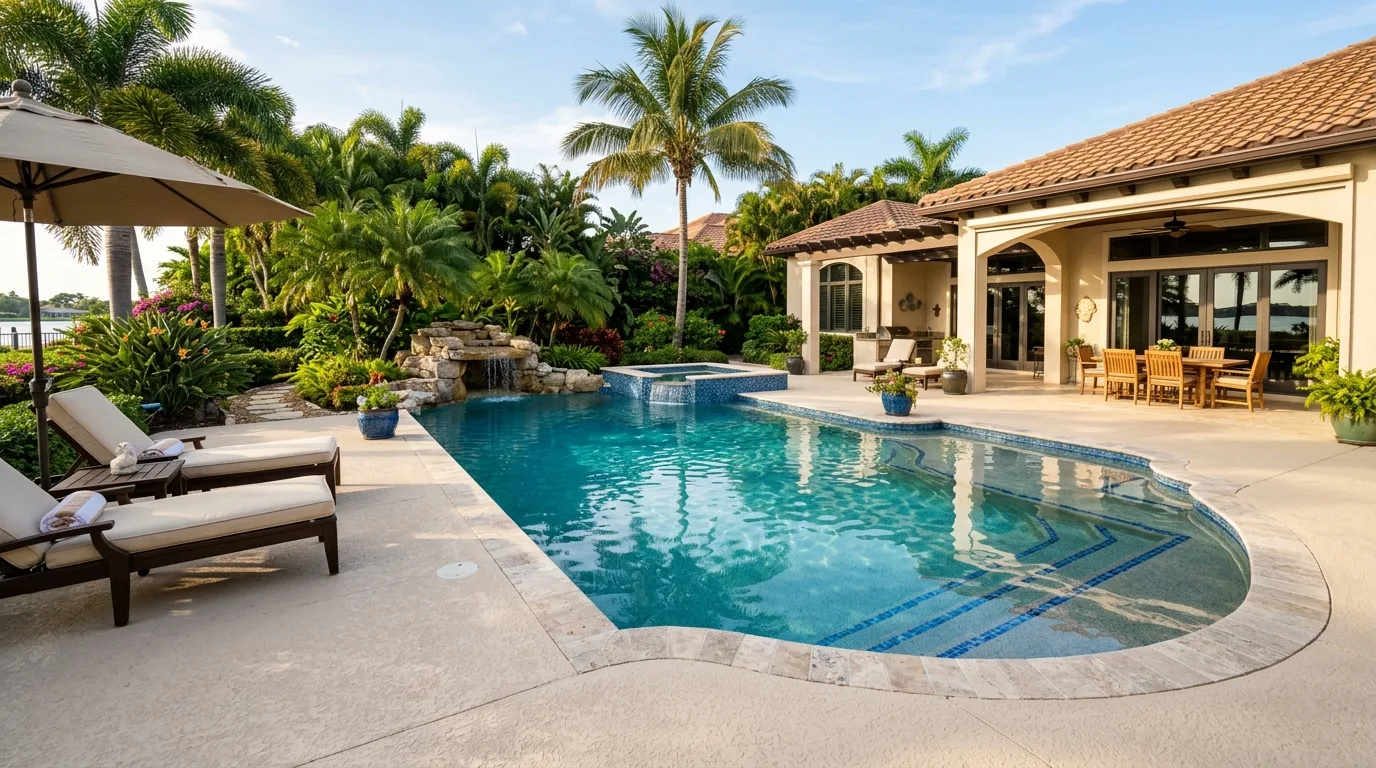
A pool deck is one of the hardest-working surfaces on a South Florida property. It has to look great for outdoor entertaining, stay cool enough to walk on barefoot in July, resist slipping when wet, and hold up to years of chlorine splash, UV radiation, and the repeated wetting and drying cycle that South Florida’s climate delivers year-round. For Wilton Manors homeowners, concrete is the most versatile and cost-effective material for meeting all of these demands — but the finish choice makes an enormous difference in both performance and appearance. In this post, we’ll cover the best concrete finishes for pool decks, Broward County’s specific code requirements, what drives cost on a typical project, and how to maintain a deck that stays safe and beautiful for decades.
Call +1(888)376-0955 for a free pool deck estimate in Wilton Manors and throughout Broward County.
Why Pool Deck Material Choice Matters in Wilton Manors
Broward County sits on the Atlantic Coastal Ridge with oolitic limestone bedrock overlaid by sandy fill. Sandy soils drain rapidly but have poor load-bearing without proper compaction; oolitic limestone near the surface can create uneven settlement. South Florida’s hot-humid climate — wet season (June–September) with daily thunderstorms and hurricane risk, dry season (November–April) with temperatures 50–85°F — means concrete curing and work scheduling are significantly affected. Salt air from the Atlantic accelerates corrosion of uncoated metal reinforcement, and UV radiation degrades unsealed concrete surfaces faster than in northern climates.
For pool decks specifically, the combination of chlorinated water splash, near-constant sun exposure, and foot traffic from wet swimmers creates a uniquely demanding surface environment. An improperly finished or unsealed concrete pool deck will show surface scaling, color fading, and slip hazards within a few years. A properly specified, finished, and sealed pool deck, on the other hand, provides a beautiful and safe surface for 20–30 years with routine maintenance.
Heat management
The #1 concern for South Florida pool decks is heat. Dark surfaces in direct Florida sun can reach temperatures that are painful or even dangerous for bare feet. Concrete pool decks can be finished in lighter, heat-reflective colors that significantly reduce surface temperature. Kool Deck and similar cool-coat products can reduce surface temperatures by 30–40% compared to unfinished concrete.
Slip resistance
Pool code requirements and common sense both demand slip-resistant pool deck surfaces. Non-slip additive in the sealer can be applied to any concrete finish. Lighter colors and textured finishes help, and a properly textured surface is a non-negotiable safety requirement.
Durability with pool chemicals
Concrete that is properly sealed resists the minor chemical exposure from pool splash-out. The sealers used in South Florida applications are specifically formulated for UV resistance and chemical exposure.
Types of Concrete Pool Deck Finishes
Broom finish is the standard baseline — a slightly textured surface created by dragging a stiff broom across the fresh concrete just before it sets. The texture provides traction underfoot when wet, which is a non-negotiable safety requirement for any pool deck. Broom finish is the most affordable option and the most common in Wilton Manors residential pools. With a quality sealer and regular resealing, it holds up well under South Florida conditions.
Salt finish creates a subtle, natural-looking texture by broadcasting rock salt across the concrete surface while it’s still wet, then removing the salt as it cures. The result is small round voids in the surface that provide good slip resistance and a more decorative look than plain broom. It’s a good mid-range option for homeowners who want more visual interest than standard broom at a modest cost premium.
Exposed aggregate is achieved by washing the surface paste from fresh concrete to reveal the decorative stone aggregate embedded in the mix. The resulting surface is naturally textured — often more aggressively so than a broom finish — and the varied color of the aggregate creates a visually interesting surface that doesn’t show staining as readily as plain gray concrete. Exposed aggregate is an excellent mid-range choice for pool decks: attractive, slip-resistant, and durable in UV exposure.
Stamped concrete transforms the pool deck into a design feature. The travertine pattern is the most popular stamped option for South Florida pool decks, closely followed by ashlar slate and cobblestone. Stamped pool decks at $14–$28 per square foot deliver high-end visual impact at a fraction of the cost of actual travertine tile installation, and without the grout lines that trap algae and mold in humid climates. The key for pool environments is that the sealer must include an anti-slip additive — plain stamped concrete can be slippery when wet and coated with a film-forming sealer.
Spray texture (cool deck) coating is a spray-applied cementitious finish that is specifically designed for pool decks. It creates a fine texture that remains cool to the touch even under direct Florida sun — a meaningful comfort factor when ambient temperatures exceed 90°F and decks in direct sun can reach 120°F+. Cool deck coatings are often applied over existing concrete pool decks as a restoration option.
Kool Coat and similar systems combine the spray texture concept with color pigmentation, allowing homeowners to refresh and recolor an aging pool deck without full replacement. These systems require proper surface preparation and primer application to bond reliably.
For broader decorative concrete options beyond the pool deck, see our post on decorative concrete for Wilton Manors homes.
Practical Uses for Concrete Pool Decks
- Full perimeter deck: The standard application — continuous concrete surrounding all sides of the pool with proper coping edge integration.
- Expanded entertaining area: Extending the deck beyond the immediate pool perimeter to create a patio zone for outdoor furniture, dining tables, and grilling areas.
- Pool house connection: A concrete walkway or deck run connecting the pool area to a detached pool house or outdoor kitchen structure.
- Spa surround: Elevated spa platforms adjacent to the main pool require the same 8×8 footing treatment as pool deck perimeters.
- Screen enclosure floor: If the pool area is enclosed within a screen structure, the concrete slab beneath must also meet the perimeter footing requirements per Broward County code.
Pool Deck Code Requirements in Broward County
Pool decks in Broward County must comply with the Florida Building Code and local requirements:
- Minimum width: 4 feet around the pool perimeter
- Slope for drainage: Minimum 1/8 inch per foot away from pool edge (typically 1/4 inch per foot for proper drainage)
- Perimeter footings: Pool deck and screen enclosure edges require 8×8 inch footings with a continuous #5 rebar bar
- Slip resistance: Required for all pool decks per FBC
- Permit required: Pool deck installation or replacement requires a permit
- Barrier requirements: Pool enclosures, fencing, or safety covers as required
The structural perimeter footing requirement protects against the edge settlement that can occur when wet soil cycles beneath a pool perimeter. Any contractor who proposes to pour a pool deck without proper perimeter footings is creating a code violation and a safety risk.
Your contractor should be familiar with all current Broward County and local municipal requirements. Always verify that permits are pulled before work begins.
How the Pool Deck Installation Process Works
Pool deck installation begins with design and permitting. Broward County requires a permit for pool deck construction, and the plan must show the proposed deck area, drainage direction, and perimeter footing details. Plan review takes up to 15 business days; for projects over $5,000, a Notice of Commencement must be filed before the first inspection.
Once permits are in hand, the installation sequence proceeds as follows:
Subbase preparation: The area around the pool is excavated and graded for proper drainage — critical to prevent water from pooling at the foundation or flowing toward the home. Compacted crushed stone base is installed per the engineer’s specification.
Footing forms: At all pool coping edges and screen enclosure perimeters, 8×8 inch forms are set to create the continuous footer. #5 rebar is placed continuous within the footing.
Slab reinforcement: Wire mesh or rebar is placed throughout the deck slab area. In coastal Broward County, epoxy-coated or fiberglass rebar is strongly recommended to resist corrosion from salt air and chlorinated water splash.
Pour: Concrete is poured, screeded, and finished per the selected finish type. Proper slope away from the pool coping (typically 1/4 inch per foot) is established during screeding to direct water off the deck.
Curing: The slab is cured for a minimum of 7 days before sealer application.
Sealing: A UV-resistant sealer with anti-slip additive is applied. This is the critical protective layer for South Florida pool decks and should not be skipped.
Call +1(888)376-0955 to discuss your pool deck design options — we’ll walk you through finishes, colors, and cost before you commit.
Cost Factors for Pool Decks in Broward County
Pool deck concrete in Broward County prices within the same ranges as other concrete work: $3.94–$7.87 per square foot for standard finishes, $14–$28 per square foot for stamped and decorative work (2025 pricing). Specific finish ranges:
| Finish Type | Cost per Sq Ft |
|---|---|
| Broom finish | $6–$10 |
| Salt finish | $8–$12 |
| Exposed aggregate | $10–$15 |
| Stamped concrete | $14–$22 |
| Concrete overlay (resurfacing) | $4–$10 |
For typical Broward County pool sizes:
| Pool Size | Typical Deck Area | Basic Concrete Cost | Stamped Concrete Cost |
|---|---|---|---|
| Small (12×24) | 400–600 sq ft | $2,400–$6,000 | $5,600–$13,200 |
| Medium (16×32) | 600–900 sq ft | $3,600–$9,000 | $8,400–$19,800 |
| Large (20×40) | 900–1,400 sq ft | $5,400–$14,000 | $12,600–$30,800 |
Several pool-specific factors add to the base slab cost:
- Perimeter footings: The required 8×8 inch continuous footings with #5 bar add material and labor cost that a standard flatwork pour doesn’t carry. This is code-required, not optional.
- Pool coping integration: The interface between the deck concrete and the pool coping requires careful detailing to prevent water infiltration and maintain a watertight joint. Additional labor is involved in properly flashing and sealing this joint.
- Anti-slip sealer: Specialized pool deck sealers with anti-slip additives cost more than standard concrete sealers but are necessary for safety compliance.
- Demolition of existing deck: If an old pool deck is being replaced, demolition and disposal adds $1.50–$3.00 per square foot depending on thickness and access.
- Drainage provisions: Broward County’s stormwater regulations may require specific drainage details that add cost on some lots.
For an overview of concrete sealing costs and schedules, see our post on concrete sealing in Fort Lauderdale.
Maintaining Your Concrete Pool Deck
South Florida’s climate creates specific maintenance challenges for pool decks:
- Annual cleaning. Pressure washing removes algae, mildew, and mineral deposits that accumulate in Florida’s humid environment. Use a concrete-safe cleaner rather than straight bleach, which can degrade sealers over time.
- Resealing. Pool deck sealers break down faster than sealers on covered concrete due to constant UV exposure, wet/dry cycles, chemical exposure, and foot traffic. Plan to reseal every 2–3 years.
- Crack monitoring and repair. Small cracks should be monitored and filled before they become structural problems. In the pool area, unsealed cracks can allow water to penetrate the subbase, accelerating deterioration.
- Efflorescence treatment. White chalky deposits are common on South Florida pool decks due to the wet environment. These are mineral deposits leaching from the concrete and can be treated with efflorescence cleaners and proper resealing.
Frequently Asked Questions
How often should a pool deck be resealed in South Florida?
Every 2–3 years for standard acrylic sealers, or as directed by the sealer manufacturer. In pool environments with full sun exposure and frequent chlorine splash, the UV degradation and chemical exposure accelerate sealer breakdown. Annual inspection of the sealer condition is a good practice — if the surface begins to look chalky or water no longer beads on the surface, it’s time to reseal.
What’s the best finish for a pool deck that won’t get too hot?
Lighter colors reflect more heat than darker colors, so a light beige or off-white color hardener on stamped concrete, or a light-colored exposed aggregate mix, will stay cooler than a dark gray broom-finish slab. Spray texture cool deck coatings are specifically engineered for thermal comfort and are the best choice for families with young children or elderly members who spend significant time on the deck.
Can I resurface an old pool deck instead of replacing it?
In many cases, yes. If the existing slab is structurally sound with only surface-level deterioration, a decorative overlay, spray texture coating, or new sealer system can restore the deck’s appearance and safety at a fraction of full replacement cost. A professional assessment will determine whether the existing slab is a good candidate for resurfacing.
A concrete pool deck built to South Florida standards delivers years of low-maintenance enjoyment — and it’s a project that significantly enhances both the function and value of a Wilton Manors home. Our team handles design, permitting, installation, and sealing for pool decks throughout Broward County.
Call +1(888)376-0955 or contact us online to schedule your free pool deck estimate. We serve Wilton Manors, Fort Lauderdale, Oakland Park, and surrounding communities.
Related Posts: