
Why Concrete Sealing Is Essential in South Florida
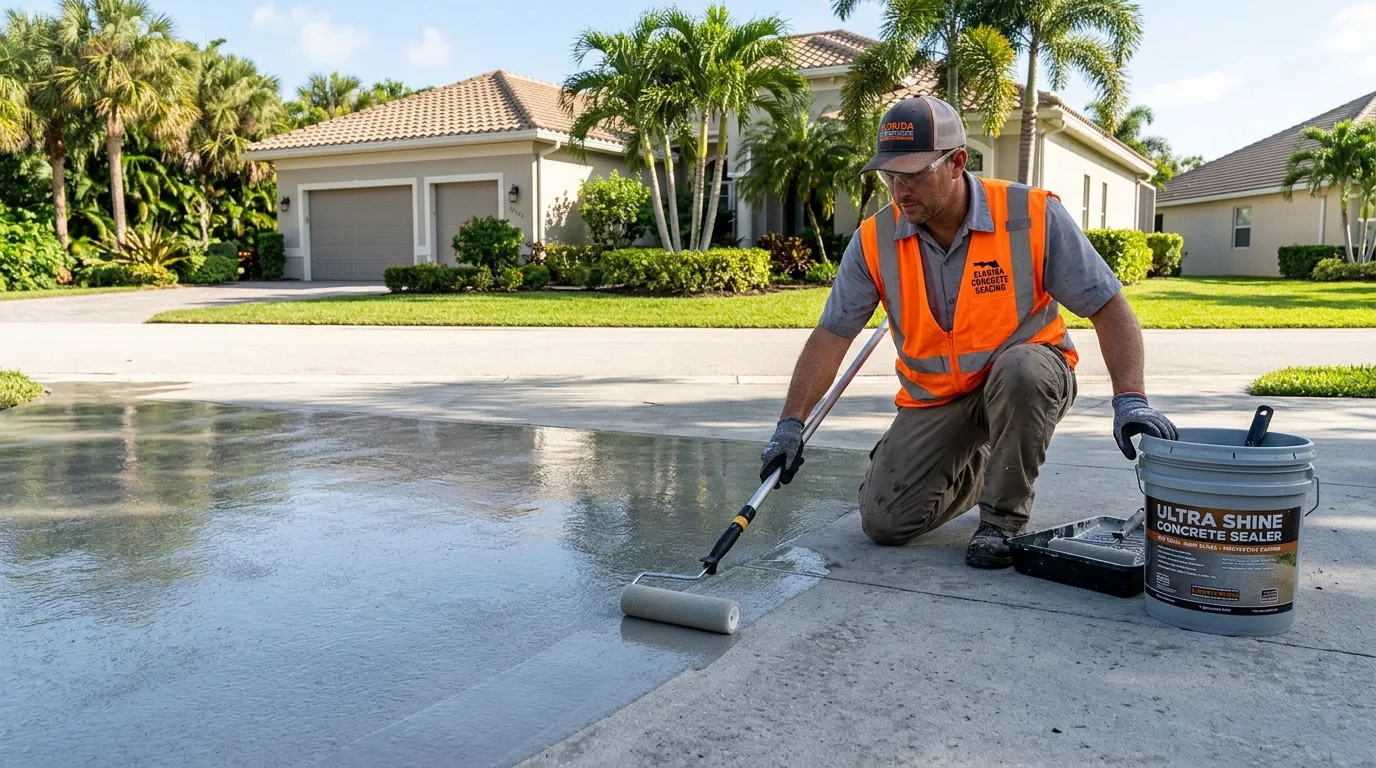
In most parts of the country, concrete sealing is a helpful maintenance step. In South Florida, it’s closer to a necessity. The combination of salt air from the Atlantic, intense UV radiation, and a wet season that brings months of daily rain creates an environment where unsealed concrete deteriorates measurably faster than in any northern climate. Homeowners in Wilton Manors and Fort Lauderdale who seal their concrete surfaces on a regular schedule protect both the appearance and the structural integrity of their driveways, pool decks, patios, and walkways. In this post, we’ll cover how sealing works, the types of sealers available, when and how often to apply them, and what the process looks like.
Call +1(888)376-0955 to schedule a concrete sealing service in Wilton Manors, Fort Lauderdale, or anywhere in Broward County.
Why Concrete Sealing Matters for Wilton Manors Homeowners
Broward County sits on the Atlantic Coastal Ridge with oolitic limestone bedrock overlaid by sandy fill. Sandy soils drain rapidly but have poor load-bearing without proper compaction; oolitic limestone near surface can create uneven settlement. South Florida’s hot-humid climate — wet season (June–September) with daily thunderstorms and hurricane risk, dry season (November–April) 50–85°F — means concrete curing and work scheduling are significantly affected. Salt air from the Atlantic accelerates corrosion of uncoated metal reinforcement; UV radiation degrades unsealed concrete surfaces faster than in northern climates.
Four climate threats combine to attack unsealed concrete here:
- Intense UV radiation. South Florida receives some of the highest UV levels in the continental U.S. Unprotected concrete surfaces bleach, discolor, and degrade faster under Florida’s sun. Decorative concrete — stamped patterns, colors, and finishes — fades dramatically without UV-resistant sealer protection.
- Heavy rainfall and wet/dry cycles. Broward County receives 60+ inches of rain annually, concentrated in the summer rainy season. Penetrating water carries minerals that crystallize as efflorescence, erodes the sand beneath slabs, transports salts that attack concrete and steel, and feeds biological growth that stains and damages surfaces.
- Salt air and chloride intrusion. Properties within several miles of the coast — virtually all of Broward County — are exposed to salt-laden air. Chlorides penetrate unsealed concrete and reach the steel reinforcement inside, causing rust expansion that fractures the slab from within. This is the primary driver of spalling on driveways, pool decks, and walkways.
- Biological growth. Florida’s warm, humid climate is ideal for algae, mold, mildew, and lichen. Beyond the aesthetic problem, biological growth retains moisture against the surface and physically penetrates the surface pores, contributing to deterioration.
The primary mechanism sealing addresses is chloride intrusion. Salt-laden air deposits chloride ions on concrete surfaces, and those ions migrate through pores and microcracks toward the steel reinforcement inside. When chlorides reach the rebar, corrosion begins. As rust forms, it expands — concrete cannot accommodate this expansion, so spalling and structural fracturing follow. A quality sealer — properly applied and regularly maintained — blocks this pathway and dramatically extends slab life.
What a Good Sealer Does
A quality concrete sealer creates a protective barrier that:
- Blocks UV radiation — prevents color fading and surface breakdown
- Repels water — reduces moisture penetration and wet/dry cycling
- Resists staining — oil, grease, and environmental stains wipe off instead of absorbing
- Deters biological growth — the sealed surface is less hospitable to mold and algae
- Enhances appearance — wet-look sealers deepen color; matte sealers provide a natural look
- Extends lifespan — sealed concrete lasts significantly longer in Florida’s climate
Types of Concrete Sealers
Penetrating silane-siloxane sealers are the gold standard for structural protection in South Florida. These sealers penetrate the concrete matrix and chemically bond with the silica, creating a hydrophobic barrier inside the concrete itself. They do not form a surface film, so they cannot peel, bubble, or delaminate. They do not change the concrete’s appearance significantly, and they allow the surface to breathe — preventing moisture from becoming trapped inside. These are the preferred choice for driveways, sidewalks, and any surface where structural protection is the priority. Reapplication is every 3–5 years; virtually invisible once applied, with no stripping required between coats.
Acrylic sealers form a film on the surface and are available in matte, satin, and high-gloss finishes. They provide good moisture resistance and UV protection and can enhance the color of decorative or stamped concrete. The trade-off is shorter service life — acrylic sealers typically need reapplication every one to two years in South Florida’s conditions, versus two to three years for penetrating sealers. They are the most common choice for pool decks and decorative surfaces where appearance matters.
Epoxy and polyurethane coatings are the most durable topcoat options. Epoxy provides excellent abrasion resistance and is common for garage floors and workshop slabs. Polyurethane topcoats offer UV resistance that straight epoxy lacks, making them better suited for outdoor South Florida applications. These coatings are more expensive to apply and require thorough surface preparation — bond failure from inadequate prep is the most common cause of coating failure. Reapplication is every 5–7 years.
Wet-look and enhancing sealers create a high-gloss, “wet” appearance that dramatically enhances the color of concrete, especially decorative work. They are ideal for stamped concrete patios and driveways where maximum visual impact is the priority. Best applied to shaded or covered areas — direct sun can accelerate deterioration of exposed film-forming surfaces.
Penetrating epoxy sealers combine the deep penetration of a silane-siloxane with the bonding properties of an epoxy system. These are increasingly used for driveways and high-traffic commercial applications in coastal areas.
How Often Should You Seal?
South Florida’s climate means you should seal concrete more frequently than the national average:
| Concrete Type | Recommended Interval | Notes |
|---|---|---|
| Driveways | Every 2–3 years | More often near the coast |
| Patios | Every 2–3 years | Annual inspection recommended |
| Pool decks | Every 1–2 years | Constant exposure to water and chemicals |
| Sidewalks | Every 3–5 years | Penetrating sealer recommended |
| Decorative / stamped | Every 1–2 years | Color protection is critical |
Signs Your Concrete Needs Resealing
- Water no longer beads on the surface (pour a small amount — if it soaks in immediately rather than beading, the sealer has failed)
- Faded color on stamped or colored concrete
- Efflorescence (white mineral deposits) appearing
- Mold or algae growth becoming a recurring problem
- Increased staining — oil and other substances absorbing rather than wiping off
- Surface erosion — aggregate becoming more visible as cement paste wears away
Practical Uses for Concrete Sealing
- Driveways: Sealing every two to three years protects against chloride intrusion and UV surface degradation, extending driveway life by a decade or more.
- Pool decks: Acrylic or polyurethane sealers protect against pool chemical damage, UV, and wet-dry cycling while improving slip resistance when a non-skid additive is included.
- Patios and screen enclosure floors: Sealers maintain the appearance of decorative finishes and prevent moisture intrusion that leads to efflorescence and surface scaling.
- Sidewalks and walkways: Penetrating sealers protect pedestrian surfaces from chloride damage without altering the broom texture or creating a slippery surface.
- Garage floors: Epoxy or polyurethane coatings protect against oil stains, abrasion, and moisture vapor transmission from below the slab.
- Retaining walls: Sealing the face of concrete retaining walls prevents water infiltration and reduces efflorescence from moisture moving through the wall.
The Sealing Process
Proper sealing starts with surface preparation — the step that determines whether the sealer will perform or fail. The concrete must be clean and dry. Any existing sealers, coatings, or surface contamination must be removed. Oil stains are degreased and treated. Cracks are filled before sealing, not after — sealing over open cracks traps moisture inside and accelerates deterioration.
Cleaning is done by pressure washing and, for contaminated surfaces, chemical treatment. After cleaning, the surface must dry completely. In South Florida, this means waiting for at least 24 to 48 hours of dry weather — ideally during the November through April dry season when humidity cooperates. Sealer applied over residual moisture will trap water beneath it, causing bubbling, whitening, and premature failure.
New concrete should cure fully before sealing — minimum 28 days. Sealing too early traps moisture and can cause adhesion failure or blistering.
Penetrating sealers are applied by roller, brush, or pump sprayer in one or two coats. The first coat soaks into the surface; excess is worked back in or removed. The second coat, if specified, is applied after the first has dried. Acrylic and polyurethane sealers are applied in thin, even coats — applying too thickly is a common mistake that leads to an uneven finish and prolonged dry time.
Traffic restrictions vary: foot traffic is typically allowed after four to six hours; vehicle traffic after 24 to 48 hours. Full cure takes 72 hours in most conditions.
Ready to protect your concrete before the wet season? Call +1(888)376-0955 — our team handles cleaning, crack prep, and sealing throughout Broward County.
Professional vs. DIY Sealing
Sealing concrete is a project that can be accomplished by motivated homeowners. DIY requires thorough surface preparation (pressure washing, stripping old failed sealer if needed), proper sealer selection for the specific application and climate, application equipment, and appropriate conditions (dry weather, mild temperatures, low humidity — challenging in Florida).
Hire a professional when working with decorative concrete (improper sealing can permanently damage the appearance), large areas (commercial-grade application equipment achieves better results), failed sealer removal (chemical stripping and prep is labor-intensive), or first-time sealing on new concrete (critical to get right; affects adhesion for years).
Cost Factors
Sealing is one of the lowest-cost, highest-return maintenance investments for concrete in South Florida. Professional sealing for a standard two-car driveway typically runs $200 to $500 depending on surface area, sealer type, and extent of prep work required. Pool deck sealing runs higher due to the specialized coatings and additional prep involved. Epoxy and polyurethane coatings for garage floors run $3 to $7 per square foot installed, depending on the coating system and surface prep required.
Concrete repair in Broward County runs $6.50–$14.00 per square foot — multiples more than the cost of sealing. A driveway sealed consistently every two to three years will outlast an identical, unsealed driveway by a decade or more, making the math straightforward: sealing is the most cost-effective tool available for protecting concrete in South Florida.
FAQs
How do I know when my concrete needs to be resealed?
The water bead test is the simplest method: pour a small amount of water on the surface. If it beads up and rolls off, the sealer is still active. If it soaks in immediately, the sealer has worn through and resealing is needed. Visually, a sealer that is peeling, flaking, or showing white hazy patches has failed and should be removed and replaced.
Can I apply concrete sealer myself?
Consumer-grade sealers are available at home improvement stores. For standard maintenance sealing on a sound surface, a careful DIY application is possible. However, surface prep is the critical variable — inadequate prep leads to poor adhesion and rapid failure. If your concrete has active cracks, spalling, or existing coating that needs removal, professional application is the better choice.
Is it safe to seal pool deck concrete?
Yes — pool deck sealers are specifically formulated for this environment. Non-skid additives are mixed into the sealer to maintain required slip resistance around pool edges. Sealing pool decks also protects against chlorine and chemical damage that degrades untreated concrete over time.
Is there a best time of year to seal concrete in Broward County?
The dry season — November through April — offers ideal conditions: lower humidity, moderate temperatures, and minimal rain. Sealer applied during the wet season risks moisture contamination during application and insufficient drying time between rain events.
Protect your concrete investment with professional sealing. Call +1(888)376-0955 or request a free estimate online. We serve Wilton Manors, Fort Lauderdale, and all of Broward County.
Related posts: