
What to Expect During Concrete Driveway Installation in Florida
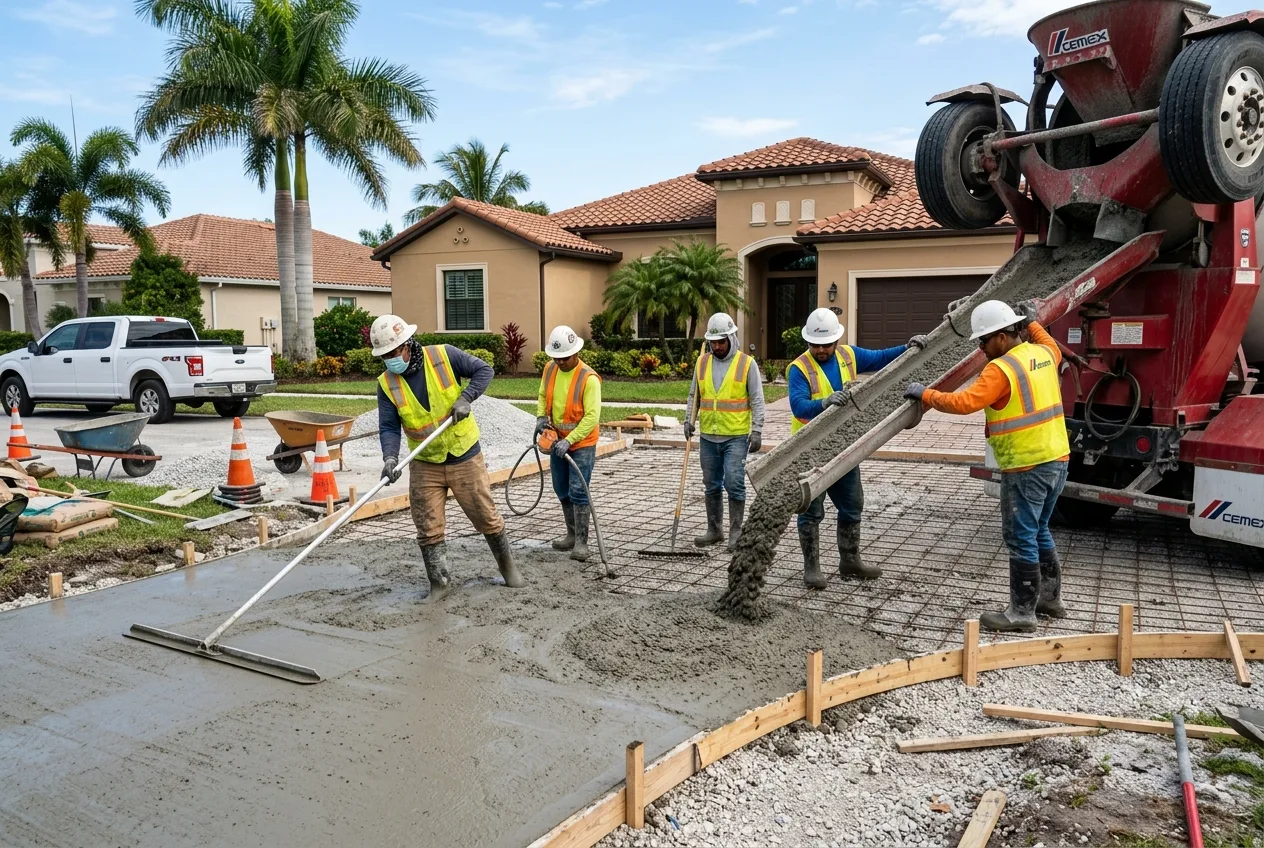
Understanding the concrete driveway installation process helps you be a better-informed customer, spot potential issues before they become problems, and have realistic expectations about timeline and logistics. Whether you’re in Wilton Manors, Fort Lauderdale, or anywhere in Broward County, here’s exactly what should happen when you have a new concrete driveway installed.
Ready to Get Started on Your Driveway?
Wilton Manors Concrete provides transparent, professional driveway installation throughout Broward County. Get your free estimate today.
Request Free EstimateBefore Work Begins: Permits and Planning
Permit Acquisition
Before any physical work starts, your contractor should obtain the required permits from your municipality (City of Wilton Manors, Fort Lauderdale, etc.) or Broward County. This typically takes 1–3 weeks.
Red flag: A contractor who wants to start immediately “to save time and money” by skipping permits is a contractor to avoid. Unpermitted concrete work creates problems at home sale and potential forced removal.
Utility Marking
Florida 811 “Call Before You Dig” notification is required before any excavation. Utilities will mark underground lines (water, gas, electric, cable, irrigation). This protects you, the crew, and prevents damage to underground infrastructure.
Pre-Construction Survey
A good contractor should measure the area, identify any drainage considerations, discuss tree root concerns, and confirm the design details before crews arrive.
Day 1: Site Preparation
Site prep is arguably the most important step. Florida’s sandy soil requires careful attention to get a stable, long-lasting base.
Existing Concrete Removal
If replacing an existing driveway, demolition is the first task. Concrete is broken up (usually with a jackhammer or mini excavator), loaded into trucks, and hauled away. Expect this to take half a day to a full day for a standard driveway.
You can read more about the decision between repair and replacement in our guide on concrete driveway repair vs. replacement.
Excavation and Grading
The ground is excavated to the required depth — typically 6–8 inches below finished slab level in South Florida to accommodate the base and concrete thickness. Proper grading ensures the finished driveway slopes away from your home (minimum 1/8 inch per foot) and toward the street or drainage areas.
Subgrade Compaction
This step is critical in Florida’s sandy soils. The excavated soil must be thoroughly compacted to prevent future settlement. In areas with poor bearing capacity or organic soils, additional compaction or soil stabilization may be required.
Gravel Base Installation
A 4–6 inch gravel base (crushed stone or limerock in Florida) is installed and compacted. This provides drainage, distributes load, and creates a stable platform for the concrete. Skipping or skimping on the base is the most common shortcut that leads to driveway failure.
Day 2: Forms and Reinforcement
Form Setting
Wood or metal forms are set to define the driveway’s perimeter, shape, and finished height. This is where curves, decorative borders, and drainage swales are established. Take time to verify the forms match your planned layout before concrete is poured.
Steel Reinforcement
For Florida driveways, we typically use:
- Rebar: #3 or #4 rebar on 24-inch centers (stronger and preferred for most driveways)
- Wire mesh: Sometimes used, but rebar is superior for crack prevention
- Fiber reinforcement: Polypropylene or steel fibers added to the concrete mix for additional crack resistance
The reinforcement should be supported on chairs (small plastic supports) to ensure it sits in the middle third of the slab thickness — not lying on the ground.
Want to Understand Your Specific Project?
Use our assessment quiz to evaluate your driveway project and get tailored recommendations.
Take the Project QuizConcrete Pour Day
Mix Design
Florida driveways should use 4,000 PSI concrete minimum. The mix design should also account for:
- Water-cement ratio: Critical for durability
- Air content: Not required for Florida (no freeze-thaw), but some contractors include fiber
- Admixtures: Water reducers, retarders (essential on hot Florida days), or accelerators
Pour Timing
Ideally, concrete is poured in the morning in South Florida. Afternoon pours in summer heat create problems:
- Rapid surface drying leads to plastic shrinkage cracking
- Hot concrete loses workability quickly, reducing the window for stamping
- Crews are working in the hottest part of the day
Concrete Placement
Concrete is typically delivered via ready-mix truck. Chutes, wheelbarrows, or pumps distribute it evenly. The crew screeds the concrete level with the forms using screed bars and floats.
Consolidation
The concrete is consolidated by “striking off” excess, using vibrators on thicker sections, and floating the surface. This removes air voids and brings paste to the surface for finishing.
Finishing
For standard driveways, a broom finish is applied — a stiff broom dragged across the surface creates texture for traction. For decorative work (stamped concrete, colored concrete), this is when stamps, colors, and special textures are applied.
This is time-sensitive, especially in Florida’s heat. An experienced crew has practiced timing to ensure consistent results.
Expansion Joints
Expansion joints (full-depth cuts through the slab) are placed every 10–12 feet to control where cracks occur. In Florida’s climate, proper joint placement is essential to preventing uncontrolled random cracking.
Control joints can be tooled into the wet concrete or saw-cut after initial cure.
After the Pour: Curing
Why Curing Matters
Concrete gains strength through a chemical process (hydration) that requires moisture. If the surface dries too quickly, the concrete won’t reach its design strength and surface cracking is likely.
In Florida’s summer heat and wind, this is a real risk. Proper curing methods:
- Curing compound spray: Most common — a liquid membrane that slows evaporation
- Wet burlap or curing blankets: Physical moisture retention
- Plastic sheeting: Creates a microclimate to retain moisture
Curing Timeline
- 24–48 hours: No foot traffic
- 3–5 days: Limited foot traffic only
- 7 days: Light vehicle traffic may begin
- 28 days: Full design strength achieved
Don’t let anyone rush you on this timeline, especially in hot weather.
Sealing: The Final Essential Step
Once the concrete has fully cured (minimum 28 days), sealing should be applied. As we discuss in our concrete sealing guide for South Florida, sealing is essential in Florida’s climate to protect against UV, rain, salt air, and staining.
Realistic Project Timeline
| Phase | Duration |
|---|---|
| Permit acquisition | 1–3 weeks |
| Demolition and prep | 1–2 days |
| Forms and reinforcement | 1 day |
| Concrete pour | 1 day |
| Curing (restricted use) | 7 days |
| Sealing (after full cure) | 28 days after pour |
Total from permit to final sealing: 5–8 weeks
Serving Broward County with Professional Installations
Wilton Manors Concrete follows this process for every installation, from single residential driveways to large commercial projects. We serve Fort Lauderdale, Pompano Beach, Lauderhill, and all of Broward County.
Before hiring any contractor, review our guide on questions to ask before hiring a concrete contractor in Florida to ensure you’re working with a professional who follows proper installation practices.
Get a Professional Installation from Wilton Manors Concrete
We do it right the first time. Contact us for a free driveway estimate and consultation.
Get Free EstimateCall [placeholder]