
Concrete Sidewalk Installation in Fort Lauderdale: Costs, Codes, and What to Expect
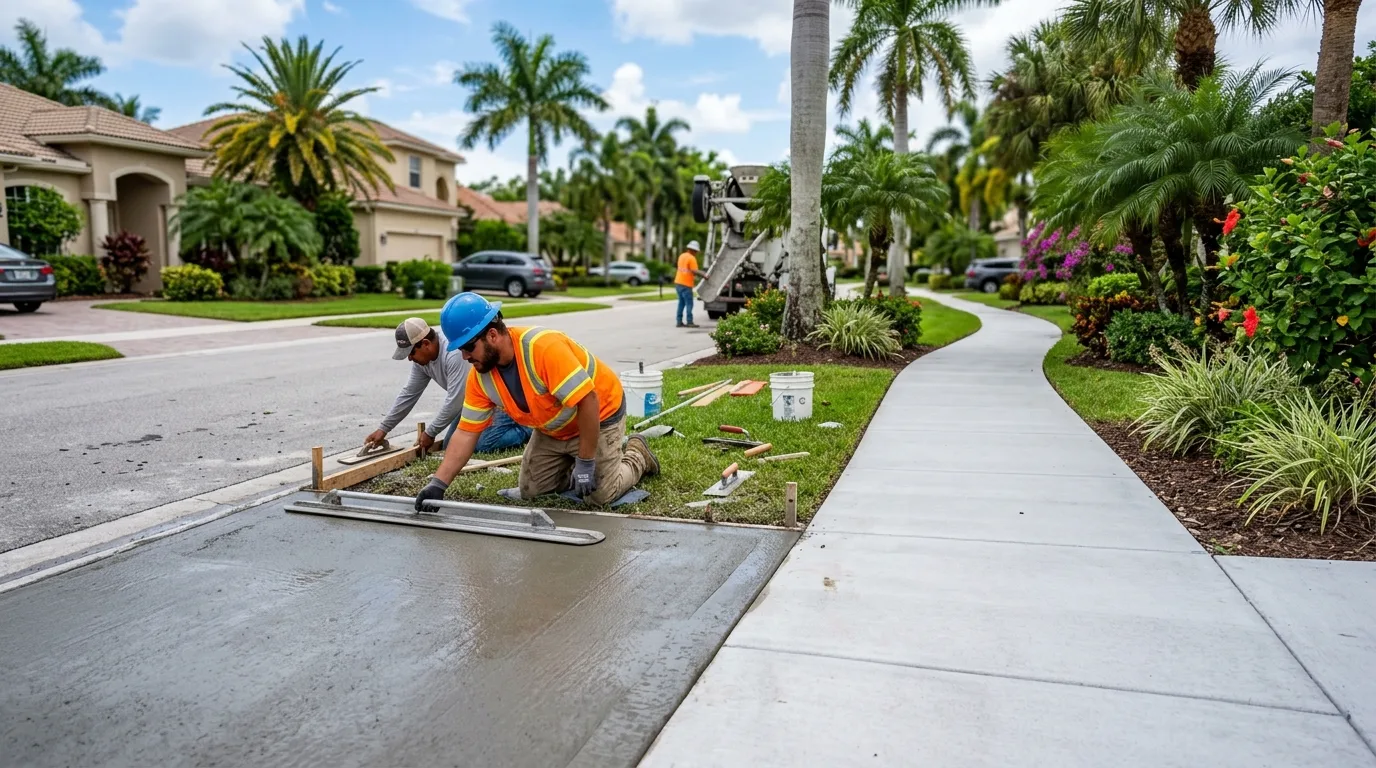
Whether you’re replacing a cracked public sidewalk panel, adding a walkway from your driveway to your front door, or installing a new path through your backyard, concrete sidewalk work in Fort Lauderdale and Broward County involves more than just pouring and finishing. Local soil conditions, permit requirements, and South Florida’s climate all influence how the job should be scoped and executed. In this post, we’ll cover permit and code requirements, the installation process step by step, and cost factors so you know what to expect before work begins.
Call +1(888)376-0955 for a free sidewalk installation estimate in Fort Lauderdale, Wilton Manors, or anywhere in Broward County.
Why Sidewalk Installation Matters for Wilton Manors Homeowners
Broward County sits on the Atlantic Coastal Ridge with oolitic limestone bedrock overlaid by sandy fill. Sandy soils drain rapidly but have poor load-bearing without proper compaction; oolitic limestone near surface can create uneven settlement. South Florida’s hot-humid climate — wet season (June–September) with daily thunderstorms and hurricane risk, dry season (November–April) 50–85°F — means concrete curing and work scheduling are significantly affected. Salt air from the Atlantic accelerates corrosion of uncoated metal reinforcement; UV radiation degrades unsealed concrete surfaces faster than in northern climates.
For sidewalks specifically, these conditions mean that base preparation is not optional — sandy fill must be properly compacted before any slab is poured, or the finished surface will settle unevenly. Inadequate compaction is the leading cause of cracked and sunken walkways in residential Broward County neighborhoods.
Sidewalk Types and Material Options
Standard broom-finish concrete is the most common choice for public-facing sidewalks and functional residential paths. The broom texture provides slip resistance, which matters in a climate where rain arrives almost daily during summer months. This finish is cost-effective and meets ADA compliance requirements for public routes.
Exposed aggregate concrete incorporates decorative stone into the surface finish. It provides a more refined look while maintaining slip resistance. Common in front walkways and entry paths in Fort Lauderdale and Wilton Manors, exposed aggregate costs more than broom finish but significantly less than stamped concrete.
Stamped concrete walkways replicate the appearance of pavers, brick, or natural stone at a fraction of the cost. They add curb appeal and work well for residential entry paths, pool surrounds, and connecting walkways between structures. In South Florida, stamped surfaces require regular sealing to resist UV fading and salt air damage.
Pavers as an alternative are worth noting: while not concrete sidewalks, interlocking pavers are frequently specified alongside concrete work and offer the advantage of individual panel replacement. However, they require more maintenance and can shift in sandy soils without a proper concrete edge restraint — another area where concrete work plays a supporting role.
Practical Uses for Sidewalk Concrete Work
- Public sidewalk replacement: When the City of Fort Lauderdale or Broward County requires homeowners to replace damaged public sidewalk panels, a licensed concrete contractor handles the permit and pour.
- Residential entry walkways: A poured concrete path from driveway to front door adds safety, improves curb appeal, and defines the entry without the shifting issues common to loose pavers.
- Side-yard and backyard paths: Service paths alongside homes provide durable, low-maintenance routes for trash bins, AC units, and utility access.
- ADA-compliant accessible routes: Businesses and multi-family properties often need to bring sidewalk grades and widths into ADA compliance as part of renovations.
- Driveway-to-garage connector slabs: Narrow concrete strips connecting driveways to garage side doors or workshop entries are common projects in South Florida residential work.
The Installation Process
Sidewalk installation in Fort Lauderdale follows a consistent sequence regardless of project size.
First, permits are pulled. Broward County requires permits for driveways and concrete slabs, and sidewalk work connected to or replacing public right-of-way panels involves coordination with the local municipality as well. Two complete plan sets with a Registered Land Surveyor’s Certificate may be required depending on scope. Plan review can take up to 15 business days, so factoring this into your project timeline is important.
Once permits are in hand, the area is staked and existing concrete removed if necessary. Demolition concrete is hauled off-site. The sub-base is then graded, compacted, and inspected. For South Florida’s sandy soils, this step is critical — mechanical compaction equipment is used to achieve a stable base that won’t shift when wet-season rains saturate the ground.
Forms are set to define the sidewalk width and elevation. Standard residential sidewalk thickness is 4 inches on compacted sand or crushed rock; public sidewalk and ADA routes often call for 4 inches minimum with thicker sections at curb cuts and transitions.
Concrete is poured, screeded level, and finished with the specified texture. Control joints are cut or tooled at regular intervals to manage where cracking occurs as the concrete cures and expands. In South Florida’s heat, curing blankets or wet-burlap curing are sometimes used during summer pours to slow the evaporation rate and prevent surface cracking.
The slab cures for a minimum of 7 days before foot traffic and 28 days before heavy loads. A final inspection is completed and the permit closed out.
Questions about the permit process or timeline for your project? Call +1(888)376-0955 — we handle permits for all Broward County sidewalk projects.
Cost Factors
Concrete driveway and slab installation in Broward County runs $3.94–$7.87 per square foot for standard finishes. Sidewalk work falls in a similar range, with decorative finishes — exposed aggregate, stamped — adding cost. Repair work on existing sidewalks runs $6.50–$14.00 per square foot depending on whether the issue is surface damage or structural failure requiring removal and replacement.
Additional cost factors include permit fees (which vary by municipality), tree root removal, root barrier installation to protect new work, and any grading or drainage improvements needed to protect the new slab from wet-season saturation. Projects over $5,000 require a Notice of Commencement filed with Broward County Records before the first inspection.
FAQs
Do I need a permit to replace a cracked sidewalk panel in Fort Lauderdale?
Yes. Broward County requires permits for concrete slab and driveway work. For public right-of-way sidewalk panels, you will also need to coordinate with the City of Fort Lauderdale. A licensed contractor familiar with local requirements handles this process routinely.
How thick should a residential sidewalk be in South Florida?
The minimum is 4 inches on properly compacted sand or crushed rock base. ADA-compliant routes and public-facing sidewalks may have additional requirements. Thicker sections are required at curb cuts and transitions.
How long does sidewalk installation take from start to finish, including permits?
Permit review in Broward County takes up to 15 business days. Once the permit is in hand, a standard residential sidewalk installation takes one to two days for the pour and finish. The slab needs 7 days before foot traffic and 28 days for full cure.
Ready to get your sidewalk project started? Call +1(888)376-0955 or request a free estimate. We handle permits, demolition, and installation throughout Fort Lauderdale and Broward County.
Related posts: